Showing posts with label LEAD GUITAR. Show all posts

Friday, 16 June 2017

DEAF GUITAR PLAYER? SOLUTION....


You probably take it for granted that you know how to “listen” to your guitar playing while practicing. However, the truth is that most guitarists only “hear” themselves play - they never (or only rarely) truly LISTEN. Want proof? Have you ever struggled to improve your guitar playing with some exercise, playing it over and over without any idea what was causing your mistakes? If you answered “yes”, then your guitar listening skills must improve.

Why Is “Not Listening” Such A MASSIVE Obstacle For Improving Your Guitar Playing?

Very simply: you will make little or no progress in your guitar playing if you don’t know how to accurately evaluate your playing by listening. When you aren’t able to identify WHAT causes your specific guitar playing mistakes, it becomes next to impossible to actually “fix” them. As a result, you continue to wonder why your guitar playing isn’t improving until you either learn how to listen correctly or get a guitar teacher to point out the causes of your problems to you.

How Can You Test Your Ability To Listen To Your Own Guitar Playing?
To help you test yourself, I will ask you several questions about a variety of general guitar playing skills. You will need to answer either “Yes” or “No” to each question (for yourself). Warning: if you can’t answer with a definite “YES!” to a question, then your listening skills are poor in this area. Below each set of questions I will list several action steps for you to take to refine your listening and improve your guitar playing with each skill.

Take the test below:

How Efficient Are You At Improving Your Guitar Playing (Technique) Problems?
When you struggle to play something cleanly on guitar, can you usually identify (by listening only) WHICH notes aren’t clean?
When you make mistakes at faster speeds, can you tell if the problems occur because of poor 2 hand synchronization, picking articulation, strings bleeding (ringing) together, noise from other strings or combination of the above?
If your hands get out of sync while playing guitar, can you tell EXACTLY which note of the phrase this happens on?

If you can’t answer “yes” to all of these questions, you need to improve your listening skills in this area.

Solution: Hearing some of your guitar technique flaws becomes easier at slower speeds (this is one of the reasons why you hear the common advice to “practice guitar slowly”). In addition, exaggerating your guitar playing problems to make them even MORE difficult will often make the cause of the problem easier to hear/see. This is especially true of problems that can only be detected “in real time” at faster tempos.

How Effective Are You At Improving Your Guitar Vibrato Technique?
Can you tell (by ear) the difference between vibrato done in quarter notes, eighth notes or triplets?
Do you know for sure if your vibrato locks in rhythmically with the background music you are playing over?
Can you tell for sure if your vibrato is totally in tune when you play?

All great guitarists who have vibrato mastered can hear these nuances and know right away when any of them are not right. This is what enables them to self-correct their mistakes and continuously improve on guitar.

Solution: If you cannot answer “yes” to all the questions above (without hesitation), then your vibrato REALLY needs a lot of work and your ears need to become more refined to allow you to use this technique creatively in your guitar solos.

How Good Are You At Listening To Your Own Improvising?
Can you hear which (specific) notes of your phrases sound good over the music you play and which ones don’t?
Do you hear (in real time) if the current phrase you are playing fits together well with the phrase that came before?

If you said “No” to at least one of the questions above, here is what to do:

Solution: There is no single solution to the above problems relating to improvising on guitar, since these issues can occur for a variety of reasons. However, in most cases you can improve your guitar playing in this area by slowing down and “focusing” mentally on the sound of each note over the chord (to determine if the note fits that particular chord or not). In addition, you will have a much easier time listening to yourself while improvising after you learn to play scales all over the guitar, and master the skill of fretboard visualization.

How Good Are You At Improving Your Rhythm Guitar Playing?
Can you hear if your guitar playing is locking in perfectly with the beat (and when it is slightly off)?
Can you tell at what points your rhythm guitar palm muting is becoming unintentionally lighter or harder as you play?
Do you notice when your picking articulation is becoming unintentionally softer on some notes that are harder to play?

Did you fail at least one question above? If so, then read below:

Solution: You can develop your listening skills relating to timing by first clapping your hands along to a steady metronome click. Your task is to create the illusion of the click “disappearing” (by clapping EXACTLY on top of the click). This will also develop your listening awareness for playing guitar in time. In addition, refining your picking hand articulation will make it much easier to improve your guitar playing in this area.

Now that you have gotten an honest evaluation of your ability to listen to your guitar playing, you will have a much clearer understanding of how to improve your guitar skills. Of course your guitar playing challenges will change and evolve over time, but if you consistently refine your ability to listen for and detect flaws in your playing, you will always know what must be done to improve your guitar playing to the next level.

4 GUITAR EXERCISES YOU SHOULD STOP PRACTICING


Want to make faster progress in your guitar playing? Then stop wasting your precious practice time working on things that do NOT improve your guitar skills. Here are the top 4 items too many guitar players waste time on but get no benefit from:

1. Finger Independence Exercises

Lack of finger independence in the fretting hand is a common problem for guitarists, but most exercises prescribed for this are useless in helping you develop this skill. FAR too many guitarists practice all the exercises that are supposed to help their finger independence, but still have terrible fretting hand technique. Worst of all, many guitarists assume that their lack of progress with finger independence is caused by not having found the ‘right’ exercises yet. So without understanding why their fretting hand independence is not getting better, they go further off track searching for more exercises, not realizing that the entire premise of having ‘general’ finger independence exercises is flawed.

2. Finger Strength Exercises

Most guitarists approach the topic of ‘strength’ training for guitar in a completely backwards way. Yes, strength IS important for guitar playing, BUT your ‘fretting’ hand strength is the last thing you should be focusing on. Here is why:

1. It doesn't take all that much fretting hand strength to play notes or chords on guitar (with one exception being applying wide vibrato on bent notes or double stops). Even techniques such as legato or trills take a lot LESS effort than most guitarists (who haven't mastered these skills) try to use when playing them. This leads me to my next point:

2. The reason why most people feel like they need to ‘get stronger’ in their fretting hand is because they use way too much tension in their hand to begin with - causing their arm to become fatigued from playing a lot faster than it should. Instead of using ‘more strength’ (which will only make the problem worse), the solution is to learn to optimize the amount of effort you use in the fretting hand so that excessive tension doesn't accumulate in your hands (and the rest of the body) as you play. It is the lack of control over excessive tension that causes most guitarists to become tired while playing - NOT ‘lack of strength’ (or endurance).

3. It is actually the ‘picking’ hand that needs to develop the most strength and power in order to play with a wide dynamic range and perfect articulation in any context. As you play guitar, the amount of strength needed to fret notes stays essentially the same (very low), while the amount of force/power used by your picking hand to strike the strings can change many times (from very soft to very aggressive/loud).

Unfortunately, the vast majority of strength exercises for guitar players are directed only at training the fretting hand, hurting your guitar playing in 2 ways: by never addressing the root cause of why your fretting hand gets tired in the first place and taking your focus away from the hand that actually NEEDS to become stronger!

What Should You Do Instead?

1. Stop practicing strength exercises for your fretting hand and use that extra time to learn how to optimize the amount of effort you use to play guitar so that you do not get tired quicker than you should.

2. Practice to improve your picking hand articulation to actually develop strength where it NEEDS to be developed in your technique. A simple way to practice this skill is to play your guitar unplugged for a portion of your practice time (focusing on picking as loudly as possible). Doing this will force your picking hand to become stronger.

3. Guitar Speed Exercises

Similar to fretting hand finger independence, your speed is NOT developed by any specific ‘exercise’ (or a set of exercises). Speed on guitar comes from developing many elements of your playing simultaneously, such as: improving your general technique in each hand individually, improving your hands’ ability to work together (2 hand synchronization), learning to play with optimal tension, mastering the nuances of picking articulation, using the most efficient picking hand technique, learning to think at higher speeds, plus other factors.  These components of speed are trained by focusing your mind on refining the technical motions that make speed possible. Because of this, it really doesn't matter what exercises you practice - you can build speed with literally ‘any’ exercise, as long as your mind is focused on the right things while practicing it.

On the other hand, the problem with ‘speed exercises’ in particular is that they attempt to reduce the multi-dimensional process of building speed down to a one-dimensional set of repetitive motions with your mind often totally disengaged from the process. They also fill you with false expectations that a certain set of finger motions repeated progressively faster is what is needed to ‘build’ speed.

Realize that if you do not take the time to develop the technical elements that make speed possible, then mindless practicing of speed exercises will often do more harm than good to your guitar playing (by ingraining your bad technique even deeper into your muscle memory and putting you at a higher risk of injury).

What Should You Do Instead?

Instead of searching for more exercises that will get practiced in the same ineffective way, take any musical fragment that you find hard to play and focus your mind on improving a different aspect of your guitar playing each time you practice it. Practicing a single exercise with the focus on developing multiple elements of your technique will give you far more results than practicing 100 different exercises by mindlessly trying to ‘move your fingers faster’.

4. Exercises That Don't Help You To Reach A ‘Specific’ Goal

Too many guitarists spread themselves too thin, practicing every new exercise that comes along, but never really thinking about how or why a certain item helps them to achieve a specific result in their playing.

From now on, every time you are tempted to practice a certain item or an exercise, put it through the “Why” test. Simply ask yourself: “Why should I practice this?” “What ‘specific’ benefit will this item/exercise help me to achieve?” If you cannot answer this question in a way that sounds convincing and compelling to yourself, then what you are about to practice is likely to be a big waste of your guitar practice time.

Note: Some practice items may be very effective ‘in general’, but will be a waste of time ‘for you’ if you do not understand exactly how and WHY an exercise will help you improve your guitar playing. As explained above, no exercise will make you a better guitarist if you simply go through the motions of moving your fingers on the guitar mindlessly. Unless you are aware of the most important things to focus on when practicing an exercise (in order to reach the objective it’s supposed to develop), then you will be better off not practicing it at all until you are clear on exactly what to focus on while working on it.

Now that you have more clarity about what things waste your guitar practice time and hurt your progress, go through your practice schedule and critically analyze every item in it. Replace the materials that waste your time with more effective ones (or improve your effectiveness at practicing the items that already are in your schedule) and you will start making much faster progress every time you practice guitar.

GUITAR PRACTICE: FIXING UP MISTAKES


Your ears and mind are your most important guitar practice tools. Your ears help you identify specific causes of your guitar playing challenges and mistakes. Your mind trains your hands to make your guitar technique more efficient, accurate and effortless.

Most guitar players struggle to hear mistakes that occur at fast speeds. Notes go by quickly and you may only notice that something does not sound right…but not know why. Worst of all, some mistakes only occur near your maximum speed and disappear when you slow down.

These guitar practice methods help you identify and fix mistakes near your top speed without having to slow down:

Guitar Practice Method #1: Emphasize The Problem

Emphasizing the problem allows you to:
Have more time to hear sloppy notes while playing at or near your top speed.
Clean up your sloppy mistakes in the context of the original exercise.

Guitar Practice Method #2: Isolate The Problem

Isolation practice is about extracting a challenging group of notes from the context of the exercise (or guitar lick) and:
Practicing it over and over (in isolation) until it is mastered.
Inserting the challenging part back into the exercise to practice it in context.

Notice the important difference between emphasizing and isolating your guitar playing problems. Emphasizing a problem allows you to clean up your playing while practicing in context the entire time. It is most useful for refining an exercise or technique you can already do well and are close to mastering.

Isolating the problem allows you to focus only on the sloppy notes at peak intensity without being distracted with the other notes of your practice item. This method is most applicable when you are making big changes in your technique or are learning a brand new guitar technique for the first time.


Guitar Practice Method #3: Exaggerate The Problem

Sometimes it’s hard to identify causes of your guitar playing mistakes even after trying to emphasize and isolate them. Exaggerating your guitar playing challenges makes the symptoms of the problem more obvious and easier to observe. This allows you to identify the causes of the challenge and fix it more easily.

Examples of exaggerating your guitar playing problems include:

1. Playing even faster - if your playing first begins to sound sloppy at 100 beats per minute, increase the tempo to 110 beats per minute and practice at that higher tempo.

Doing this helps you to:
Feel the effects of the problem more clearly (so you can identify their causes and solve them).
Make the original tempo (100 beats per minute in this example) feel much easier by comparison.

2. Play guitar unplugged (at your maximum speed). This challenges your articulation (and 2-hand synchronization), so you can identify which notes are not perfectly clean. After you identify the sloppy notes, apply the emphasis or isolation guitar practice method to master what you are practicing.

Note: playing unplugged also helps your legato playing to become cleaner and more articulate.

This video shows you more examples of exaggerating your guitar playing problems so you improve your guitar technique faster.

Use these guitar practice methods to speed up your progress and make your guitar playing sound better.

Monday, 29 May 2017

HOW TO READ GUITAR TAB


HOW TO READ GUITAR TAB


Guitar tablature, or just tab for short, is a notation system that graphically represents the frets and strings of the guitar. Tab is guitar-specific, and it tells you what string and fret to play. Use the tab if you’re ever unsure as to which fret or string a note falls on.


Music for guitar usually comes either in tab or with two staffs, one using standard music notation (the one with the treble clef), with a tab staff just beneath it, like most of the examples of guitar music you’ll find on this site. The tab staff aligns with and reflects exactly what’s going on in the regular musical staff above it, but it’s in guitar language.
The following figure shows a tab staff and some sample notes and a chord. Here are a few points to keep in mind when reading tab:
The lines of the tab staff represent guitar strings, from the 1st string on top (high E) to the 6th string on bottom (low E).
A numeral appearing on any given line tells you to press, or fret, that string at that numbered fret. For example, if you see the numeral 2 on the fourth line from the top, you need to press down the 4nd string (D) at the 2nd fret (actually, the space between the 1st and 2nd fret, closer to the 2nd metal fret wire).
A 0 on a line means that you play the open string — that is, unfretted, with no left-hand finger touching the string.
When you see stacked notes, as in bar 3 of the figure, that notation tells you to play the fretted strings all at the same time, which produces a chord. The fretted strings in the figure form a D major chord.

CIRCLE OF FIFTH


CIRCLE OF FIFTHS

Understanding how to read the circle of fifths will help you understand the relation between music’s major keys and their relative minor keys. A major key and its relative minor use the same key signature, which means they use the same sharps (indicated as #) and flats (shown as b) in their scales. When you read the circle of fifths, you’ll notice that the major keys are on outside of the circle. Opposite them, inside the circle, are their relative minor keys.


At the top, you have the key of C major, which has no sharps or flats in its key signature. Each stop on the circle as you go clockwise from C is a key with one more sharp than the previous key. Each stop as you go down counter-clockwise from C is a key with one more flat than the previous key.So, if you have the circle of fifths memorized (or have a picture of it handy), you can easily figure out what key a song is in. Simply count the number of sharps or flats in the key signature, and then move that many spaces around the circle of fifths, starting at C. Move clockwise for sharps, and counter-clockwise for flats.For example, if you see three sharps (F#, C#, and G#) in the key signature, start from C and go clockwise three places, and you’ll find that the song is in either A major or F# minor. Similarly, if you see five flats (Bb, Eb, Ab, Db, Gb) in the key signature (not a nice thing to do to a guitarist), you start at C and go five places counter-clockwise; that puts the song in either Db major or Bb minor.

OPEN CHORD POSITION


PEN POSITION CHORD


These 24 chords make-up just about all the chords you need for rock guitar in open position

GUITAR SOLOING AND DOMINANT SCALE


GUITAR SOLOING AND THE DOMINANT SCALE

Think back to the moment when you just learned to improvise on guitar and played your first licks in the minor pentatonic scale. It felt awesome to be able to play over a backing track, to create your own guitar solos and to express the way you felt by means of guitar playing. You saw your improvisation qualities improve rapidly and it felt like some kind of magic. As you mastered the minor pentatonic scale completely, you may have noticed that you got stuck and your soloing didn’t improve much anymore. In this article we will talk about a few simple techniques to break through these limitations and take your blues guitar soloing to a whole new level.

How Your Blues Guitar Frustrations Are Tied To a Very Limited View of How Blues Scales And Chords Work
You have learned about the minor pentatonic scale and learned to improvise a bit, but you’ve come to a point where you don’t make progress anymore. You want your blues guitar solos to sound like the ones played by your favorite blues guitarists, but you feel like you’re stuck in the same old patterns and licks. You know your guitar playing can improve, but you have no clue how to do it. Sounds recognizable? These frustrations are shared by many guitar players around the world! Let’s look at how this happens and how to overcome these guitar playing barriers.

Why You Are You Stuck In A Rut With Your Blues Guitar Playing
A large share of beginner and intermediate guitar players only make use of the minor pentatonic scale to solo over a dominant blues progression. Adding up to this, they use the minor pentatonic scale over ALL chords in this blues progression, which makes their solos sound less interesting and definitely not professional. Most of these guitarists think they’re doing it the correct way, but actually they only use a very basic method of soloing.


The minor pentatonic and the blues scale are the most common ways to play over a dominant blues progression, but these are definitely not the best ways of soloing if you want to sound like your favorite blues guitarists. If you want to break through your limitations and come a step closer to sounding like your favorite guitar hero, you need to explore more melodic ways of creating a blues guitar solo.


If you would like some more detailed reasons why using the minor pentatonic scale over ALL chords in a blues progression is not the best method of soloing, In this article specifically we’ll look at how to overcome these barriers by learning how chords and scales work together.


Overcoming Your Blues Guitar Frustrations By Understanding How Chords and Scales Are Related
To illustrate how chords and scales are very deeply intertwined, we start from a standard 12 bar blues progression in the key of A, with the following chords:
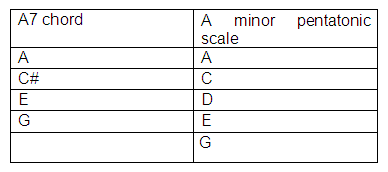
The most common and basic approach would be to improvise over this progression using the A minor pentatonic scale. To understand how this scale is linked with the chords being played, we’ll break down the A7 chord, which is a dominant seventh chord. Basically, such a dominant seventh chord is built up using 4 notes:


- The Root note (R) : A
- The major 3rd (3) : C#
- The 5th (5) : E
- The flat 7th (b7) : G


As the A7 chord contains these four notes, they are also a great choice to land on when soloing. They will sound really good, because these tones can be found within the chord. If you pick these notes to land on over an A7 chord, you will be able to give a more melodic feel to your lead guitar playing and your solos will have a lot more appeal to them. Depending on which of the four notes you pick, you will produce a different emotion. Try experimenting with different notes and listen to the feeling they give you!


As you may have noticed, the A minor pentatonic scale doesn’t contain the C#-note. That’s why we will use an expanded version of the scale to play over the dominant seventh chord A7: the A minor pentatonic scale with an added major third


A minor pentatonic scale (with added major 3rd)


It’s important that you realize that there are better options that we could choose than only using the minor pentatonic scale. Let me break it down for you why this is.


The A7 chord contains 4 notes, which we already looked at. You see these notes again in the left colomn below. In the right colomn you see the five notes of the A minor pentatonic scale.


As you see in the table above, the C# note in the A7 chord clashes with the C note of the A minor pentatonic scale. Try this out for yourself on your guitar, play a C note and play a C# note an octave higher; not the best sound in the world right?


Of course, a little dissonance never killed nobody and sometimes that dissonant C note might even be the perfect sound that we are after. But there will be times where you want to sound more melodically and you want to hit the perfect note at the perfect time.


Taking Your Guitar Playing to Blues Heaven By Applying Chord Tone Soloing


An approach that many great guitarists use to target the right notes over a chord progression is called “Chord Tone Soloing”. This means that you don’t play in one pentatonic scale over ALL chords, but you connect the chords being played in the progression with a certain scale. To clarify this, we start from the same standard 12 bar blues progression in the key of A as in the previous section.


First off, let’s take a look at what a lot of beginner/intermediate guitarists think is the correct way of Chord Tone Soloing. Further on, I will elaborate on the correct approach and teach you how to apply it correctly.


When Transposing Goes Horribly Wrong
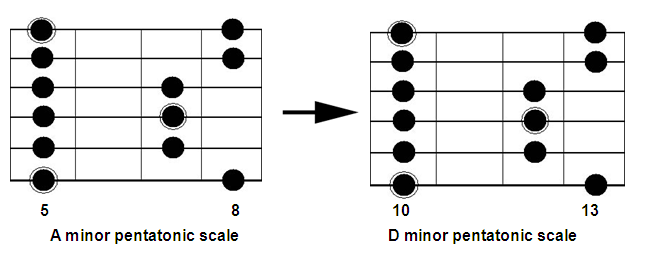
For example, if in the progression above the D7 chord is being played, a possible (but WRONG) solution would be to play some licks in the D minor pentatonic scale over this chord instead of staying in the A minor pentatonic all the way.


To clarify this, take a look at exactly how this wrong assumption looks on the fretboard of the guitar:


By transposing, you would be tempted to believe that the notes in the scale you are playing (the D minor pentatonic scale) will sound much better over the D7 chord than the notes in the A minor pentatonic scale. This again is a way of thinking that is common among beginner/intermediate guitarists, but definitely not a good approach.
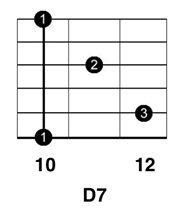
If we analyze the D7 chord and the D minor pentatonic scale, we see that the chord contains an F#, while the scale comprises an F note. Hence, if the D minor pentatonic is being played over a D7, these notes will clash and it will sound horrible.
Just transposing the minor pentatonic scale over the D chord is done by A LOT of beginner guitarists, but NO professional blues guitarist would ever dare to do this! Are you starting to see why beginner blues guitarists get stuck in their progress on the guitar? They have no clue why their guitar playing doesn’t even come close to that of the guitarists they admire; they are using the WRONG scales!


How To Tie Chords and Scales Together So That You Are Picking The Best Possible Notes Over Each Chord


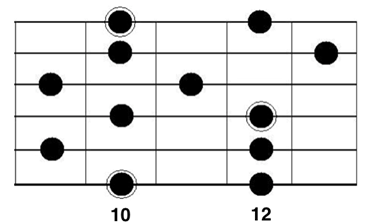
Applying what we explained in the previous paragraph, we can raise the F note in the D minor pentatonic to an F# and thus play the D minor pentatonic with added major 3rd, but there are even better ways. A more advanced approach that comes closer to how great blues guitarists apply Chord Tone Soloing, is to use the D dominant pentatonic scale. In that case we raise the F note to an F# and also play the 9th, which is the E note. This scale is completely tied to the D7 chord and therefore will sound much more professional when applied over a D7. All notes that are in the D7 chord are in the D dominant pentatonic as well. You can see this for yourself below.


This is the D7 chord:


And this is the D dominant pentatonic scale:


D dominant pentatonic scale


Notice how all the notes in the chord are covered in this dominant pentatonic scale.
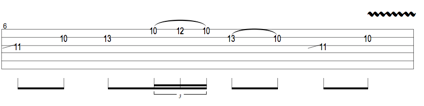
Great blues guitarists will use the D dominant pentatonic scale when improvising over the D7 chord in a dominant blues progression. For example, here is a great Stevie Ray Vaughan lick you can use over the D7 chord:

11 MISTAKE GUITAR PLAYERS MAKE


11 MISTAKES GUITAR PLAYERS MAKE

Do you know how some guitar players practice most days of the week, work hard, and are passionate about their guitar playing, but they always struggle to be able to play guitar the way they want? They are frustrated because they don’t improve fast enough, begin doubting their guitar playing potential, or even feel discouraged or angry with themselves when thinking about how long it is taking them to become a better guitar player. 
Can you relate to that? I sure can;
There are specific reasons why guitar players go through such frustration and disappointment. Here are 11 key mistakes guitar players make and repeat over and over again that you should definitely avoid.
Teaching Yourself To Play Guitar. 
Many people attempt to teach themselves how to play guitar. Yes, it’s true that some well known players were ‘somewhat’ self taught, but I do not suggest following that strategy even if your favorite player was self taught. If you are 100% sure that you can build powerfully effective learning and training systems on your own, that's great. However, if you are like most of us, doing it alone is the hardest, most time-consuming, stressful, and frustrating way to learn anything. This is a mistake that you should avoid. Some guitar players think it will impress others if they say, "I am a self taught guitar player". That statement might impress a few inexperienced people, but being self taught is not a 'badge of honor'. Would you rather impress others with your guitar playing or with an unimportant statement about your guitar playing? I'm not criticizing self taught guitar players, I'm only saying that there is no advantage to being self taught… and no, it is not true that being 'self taught' makes us more 'original'. In fact, the opposite is usually true.
Taking Guitar Lessons From Ineffective Guitar Teachers.
 Unfortunately, most electric guitar teachers receive ZERO training on how to teach guitar. What is worse is that the vast majority of teachers do little or nothing to improve their guitar teaching skills. Want some proof? Use google’s keyword tool . Type in this keyword phrase: ‘improve guitar teaching skills’, ‘guitar teaching skills’, or ‘guitar teaching training’ and you will find that less than 10 searches per month are done for these topics at google! Of course there are some highly effective electric guitar teachers around, but there are a whole lot more ineffective teachers. 
Seeking New Guitar Information (tricks, tips, tab) Without A Proven Strategy To Reach Your Specific Musical Goals. We need information, advice, help and music to play, but without a proven strategic learning and training process that is specific to you, your skill level, your musical style and what you want to be able to do as a guitar player, information won’t get you where you want to go. It is better to first seek help in developing a customized strategy for you to become a better guitar player. After that strategy is in place, then it is time to deal with learning the right information.
Not Knowing Specifically What You Want To Be Able To Play. Most guitar players are not specific enough when they think about (or tell others about) what they want to be able to do with their guitar. To say, "I want to play whatever I wish to play” is too vague. How can you (or your guitar teacher) develop a specific and effective guitar training strategy unless the goals you have are specific? It's like saying you want to be a great athlete, how can you effectively train with such a vague goal? Sure there are things you can do to become faster, stronger, more flexible or whatever, but it's much easier if you first get specific such as, I want to train to be a gymnast, or a long distance runner, or a body builder. Yes you can still improve without a strategy, but it will take a lot longer and be much more frustrating. You can always change your goal later if you discover you want to do something else instead.
Not Enough Focus On Things That Matter Most To Making You A Better Guitar Player. Have you fallen into the trap of practicing guitar without focusing on the specific things that can quickly begin to improve your guitar playing? Many people really do not understand and apply this concept in enough detail…. for example, I have a student named Mark who used to take lessons from another teacher in the past. Mark was studying sweep picking arpeggios with his previous teacher, and was making some progress. However Mark did not understand what ‘specific’ things he needed to focus on first before attempting to master the sweep picking arpeggios he was practicing. This was holding him back and making him feel very frustrated. Mark’s previous teacher only knew how to ‘teach’ arpeggios and general sweep picking concepts. He did not really know how to “train” Mark with the specific things to focus on and how to overcome the challenges Mark was having. 
To your goals: In addition to not focusing on specific things, many guitar players focus on the ‘wrong things’. Some enthusiastic guitar players become temporarily obsessed with things which are distractions from other things that could be helping their guitar playing much more. Here is an example: I used to get so frustrated and angry when I could not play something perfectly, I’d lock myself in my guitar practice room and say, “I’m not coming out of this room until I master this damn lick if it takes me the next 19 hours! No breaks! No food! No human contact! I’m gonna nail this!” And I did master it. On the surface, it might seem like I was on the right track and practicing in a good way…. But in reality, I was spending my time only to stop being angry and frustrated. I was not investing my guitar practice time wisely by focusing on the things that mattered most to making a better guitar player. In other words, my perseverance was commendable, but my strategy to master important long-term goals was weak. I allowed myself to be distracted. I don’t make this same mistake anymore, and I urge you to also avoid it! Focus on the things that really matter for your guitar playing right now. If you are not sure how to do this, seek out a proven guitar teacher today.
Focusing On The Right Things, But in The Wrong Order. This is a common mistake that even many advanced guitar players make which causes a lot of wasted time and frustration. Imagine you want to improve your ability to create your own cool lead guitar solos. Let’s assume that you are advanced enough to truly understand all the primary and secondary elements of composing guitar solos (or you have a guitar teacher to help you). Each of the many elements need to be learned and/or practiced in order to easily create awesome solos that you like. Where should you begin? What should you focus on first, second, third? Which of these things should you practice simultaneously? There is always a specific order in which musical skills should be learned and mastered in order to EXPLODE your musical skills. Unfortunately, that order is totally different for every person, style of music, musical goal, skill set and knowledge, so giving an example here would be pointless. My advice, find the best teacher you can and study with him/her in order to be able to do what you want to do with your guitar much faster and easier.
Not Isolating Problem Areas. Few guitar players are aware of the small things that hold them back in big ways. Because these little imperfections seem insignificant to us, we often ignore them. The truth is, small hinges open big doors. In the video mentioned above I explained how allowing your guitar pick to lose its momentum when you are ‘not picking’ a note on the guitar makes your playing slow and sloppy…. which will make you feel very frustrated. This is why I was sure to make a special point to help you avoid that mistake
Learning And Practicing Guitar In A Step By Step Linear Process. Does following a linear step by step approach to learning, practicing and mastering guitar seem like common sense good to you? Yes it does… And that is why guitar players who follow such a path are NOT great guitar players. I’m going to let you in an insider’s secret… The truth is, following a linear approach to learning guitar, practicing guitar, and mastering guitar is the NUMBER ONE REASON WHY “GOOD GUITAR PLAYERS” STRUGGLE TO BECOME “GREAT GUITAR PLAYERS”…
Practicing Guitar In The Same Way Your Favorite Guitar Players Practice Guitar. 
Have you ever read about how your favorite guitar players practice guitar and then tried to repeat the same practice routine? Yes, I’ve made this mistake too! It seems natural to use a similar guitar practice schedule that our favorite guitar players are using. This is a mistake, because your current guitar skill level and knowledge of music is probably very different from your favorite player. His/her challenges and needs are likely not the same as yours.
Learning From Too Many Different Sources Of Information
There will always be many learning opportunities and various paths to take, but it is critical that you do not get distracted into following a piece of advice from one person, then another piece of advice from another person and then follow more resources from somewhere else and so on and so on... while different people may have some good ideas to offer, the fact is, distraction is a big reason why many guitar players who are actively learning, don't really move forward quickly... these people are always busy following totally different resources, teachers, philosophies, instructional videos, free online guitar lessons, but all of this leads them to take one step forward, then 2 steps to the right, then one step forward, then 3 steps to the left, then one step backward, then two to the right, then 1 step forward and then another step to the left.

LEARN HOW TO PLAY DRUMS WITH A METRONOME

           Learn How To Play Drums With A Metronome The Metronome is one of the most essential tools used to develop a drummer’s sense of t...